Thursday, 8 September 2016

Digging up:Detectorists

'Climbing through the briar and bramble'
Most people who have watched this series wonder how is it possible that it was broadcast on BBC 4 only as, clearly, it deserves a much wider audience; this seems unfair because, in a perfect world, Detectorists would be shown in prime time on BBC 1 and would be acclaimed by critics and public alike.
This should be so because this sitcom, written and directed by Mackenzie Crook (better known as the infamous Gareth in The Office), is a gem bound to touch anyone who is after a comedy that is subtle, original, delicate and at times deeply moving, all in an understated way that makes it even nicer to watch; some may call it 'slow comedy' simply because it demands some time and effort for its brilliance to come forward. You won't find here canned laughter, neither slapstick nor cliches or crowd-pleasing numbers; this is humour at its best, but not the sort that will have you in tears.

Andy and Lance in the thick of it
Detectorists tells the story of friends Andy and Lance (the mentioned Mackenzie Crook and the great Toby Jones, star of the marvelous film Marvellous) whose main - and only- interest seemingly lies in metal detecting; almost an obsession.
This is, by all means, a refreshing and quirky starting point, as it puts the series in a league of its own. Episodes kick off with these two peculiar and unlikely characters in search of the Holy Grail of metal detectors (or detectorists,as they like to call themselves) in rural Essex: the Saxon hoard.
Instead, they find discarded and useless objects, though this does not seem to deter them from continuing their search. Metal detecting becomes a way of life, a philosophy, a therapy of sorts.
As with many other great pieces of art, the genius of Detectorists sits in those details that may go unnoticed at first. Crook's writing is subtle, full of awkwardly funny moments, low-key yet impossibly sublime; this is enhanced by superbly crafted characters that you grow to like and love as the series develops and the whole is made irresistible by the stunning beauty of the English countryside.
To top it all, John Flynn has written one of those songs that manage- despite or because of its simplicity-  to give you goosebumps, thus confirming, from its very first minute, that Detectorists is a series like no other. Unmissable.

Sunday, 3 April 2016

This must change everthing

A call to arms

Naomi Klein has established herself as one of the leading voices against the wrongs of our time.Her first book, No Logo (1999), quickly became influential among anti-globalisation activists worldwide and it was for many an eye-opener about the ruthless methods of  global brands that we all know about. Since then, Klein has written hundreds of articles, delivered talks, participated in conferences and actions. She was an activist as much as a thinker. Her other seminal work, written years later- The Shock Doctrine (2007)- tackles the consequences of neo-liberalism; the free-market mantra devised by Milton Friedman and happily applied by Reagan, Margaret Thatcher and company. So it is no surprise that latest publication is focused on another Damocles sword: the environment, or more specifically Climate Change.
In it, Klein argues that action needs to be taken urgently, which by the way is something environmentalists have been saying for decades. But she insists that if we continue to blindly believe in capitalism as the only way out, then we may be shooting ourselves in the foot.
Reading this in the wake of last year's Paris Climate Change Conference does not help, either. The institutional response to what science is evidencing (ie rising temperatures, ice caps melting, sea rise, etc.) is way too slow and insufficient, no matter what the triumphant headlines after the summit told us.

The book is, as you would expect,  rich in details and evidence and its scope is to preach to the non-convert and, hopefully, turn them into committed climate activists.
We're running out of time and action is required, both at an activist and institutional (aka governments) level. Reading this enlightening essay may be the first step towards a 'new deal'. The hope is that this book changes everything. For our own sake.

Wednesday, 27 January 2016

We Should All Be Feminists

We should indeed

As part of the Tea & Sympathy Book Club, last month we read this short yet enlightening book by acclaimed Nigerian author Ngozi Adichie. I must say that this short essay works wonders, or least it did in our group, since both the topic and the length were motivating factors for the group readers; I mention this because in my experience running book clubs, some people tend to be put off by lengthy books as their reading pace is slower than when they read in their native tongues.
This book stems from an equally thrilling talk given by Adichie at TED some years ago. With a title like that, I guess few people would be surprised by its content, as the author's aim is clearly laid out right from the start. The writer's own experience as a girl growing up in her country is used as guide to expose society's inherent sexism and discrimination for the simple fact of being a girl. For her, this must be challenged and in doing so she faces being ridiculed and criticised by those who label feminism as a dirty word and refuse the main principle behind the definition of a feminist: a person who believes in the social, political and economic equality of the sexes.
This book challenges stereotypes, raises awareness about an issue that is still a long way from being normalised and, ultimately, serves its purpose as an educational tool that should be a compulsory read in schools and colleges everywhere.

Friday, 18 September 2015

A History of Protest Songs

Say it loud: music with a message

It should be stressed from the beginning that this book, written by music journalist Dorian Lynskey, is a brilliant history of protest songs....mostly written and performed by US and European (ie British) artists. 
Apart form Part Three, which covers songs from Chile (Victor Jara), Nigeria ( Fela Kuti) and Jamaica (Max Romeo and The Upsetters), the rest of the book is a fascinating trip through those songs of mostly North-American and British artists, which with their powerful message and music, helped shape or were the background of social changes, upheavals, revolutions and key moments in recent history. 
I do not think that this book is solely aimed at music lovers; it is, in fact, a book that makes sure that each song chosen is given its historical context, thus enriching the story while also paying attention to other songs and artists of the time that are worth mentioning or have a special relevance in order to fully understand the context in which they were written and performed. 

Starting with the harrowing piece Strange Fruit, performed by Billie Holliday, Lynskey takes us on a journey that includes expected artists and songs (Bob Dylan's Masters of Wars, Scott-Heron's The Revolution Will not Be Televised and Public Enemy's Fight the Power), but also presents the work of other lesser known (at least in my case) songs, including the electronic dance band The Prodigy or the Welsh group Manic Street Preachers.


Chile's Victor Jara, the only non-English speaker included in the book
In any case, the book is extremely well-researched and it traces and presents in a very entertaining and informative way the circumstances in which the songs were born. Despite, or perhaps because of its length, (800-plus pages), 33 Revolutions Per Minute is one of those books that can be read at any time, you can put it down and get back to it as you please, and simply enjoy the prose and style of its author, which together with the wealth of information he provides, will make you want to listen to each of the songs here included. 

The only criticism I have is what has been written above regarding the book's scope; more cultural and linguistic diversity would be appreciated, particularly from those under-represented parts of the world (Asia, South-America, Africa...). Other than that, the book is a joy that people interested in music, history and politics should not miss.

Monday, 22 June 2015

Did you dance, Caroline?

The lizard wags its tail on the skirt of Caroline
The 'Tea & Sympathy choir' made its stellar debut at the Gentalha's social centre party last week to celebrate the end of course! We translated into English a traditional and well-known song (Bailaches Carolina?), adapting it to the music and the English rhythm, hence some minor differences between the original and the translation. We will not claim that our choir is ready to join the likes of the those gospel choirs & co that can move people to tears with their renditions of other traditional tunes, but at least we had a good laugh. Here our version of the song: 

DID YOU DANCE, CAROLINE?
Trad, arranged and translation by tea&sympathy

1 On the skirt of Carolina        
is painted a lizard,
when Carolina dances,
the lizard wags its tail.

2 Did you dance Caroline?
I danced, indeed Sir!
Tell me with whom you danced
I danced with my loved one

3 Our Carolina is crazy,
She does everything wrong
She dresses from her shoulders
and undresses through her feet

4 Did you dance, Caroline?
-I danced at the quarters.
-Tell me with whom you danced.
I danced with Sergeant Paul X 3
5 Mister priest doesn’t dance
just because he wears a crown.
Do Dance, mister priest, go on,
God forgives everything.

6 Did you dance, Caroline?
I danced, indeed, Sir.
Tell me with whom you danced.
I danced with my John (three times)

7In the farm of Caroline,
no closed cart is allowed
Only Caroline can come in
Grabbing her pig from its tail

8 With your loved one, Caroline
Never go dancin’ again,
He pulls up your skirt
And it’s hard to pull it down

Wednesday, 4 March 2015

Sally Heathcote: sufragette

Life of  a sufragette 
Emmeline and Christabel Pankhurst or Emelyn Davison are some names most people interested in the Sufragettes movement may be familiar with. However, as it is easy to imagine, the strength of this radical group of activists lay in its numbers, those committed women who fought bravely against the odds, who staged hunger strikes, who were imprisoned and risked their lives. An example of all this was the case of Sally Heathcote, whose eventful life this book is based on, which tells, in graphic novel format, the adventures of one of the most fascinating civil disobedience movements of the last centuries.
A wonderful team composed of Mary and Bryan Talbot (who published in 2012 another very interesting and acclaimed graphic novel Dotter of her father's eyes, based on a James Joyce's daughter life), and cartoonist Kate Charlesworth, deliver a true page-turner that becomes a must for readers with an interest in social history and the 'votes for women' campaigns. It is also refreshing that the book, rather than give centre stage to those better known figures, the authors chose to focus on a less known activist, who was also from a very different social background to the Pankhursts sisters and other members.

No going back


 Despite the fact of being an invented character, the device works extremely well as it brings a new perspective to a historical movement.
The novel is beautifully designed, it is a joy to read that conveys brilliantly the Sufragettes' urgency and mood. Once again, a powerful and informative book that should be read widely, particularly now that we approach 8 March, International Women's Day.

Wednesday, 3 December 2014

Exhibit B and the anti-racist dilemma

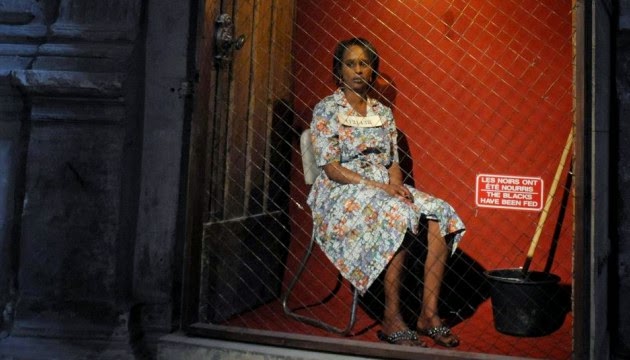
Looking right through the eyes of the subjugated
How far can art go? Where is the fine line that divides creativity and offensiveness? And who draws this line? When should a piece of art be censored? In fact, should any artistic representation be censored at all? These and other questions pile up as I read extensively about all the heated debate created around the installation/performance Exhibit B by the (white) South-African artist Brett Bailey. If I mention his colour of skin, it is simply because it bears relevance to the matter as this is one of the reasons why his artwork has sparked such controversy.
This live art installation represents a colonial human zoo in what attempts, according to Bailey, to 'explode racial and cultural stereotypes rather than reinforce them'; by placing motionless performers in different positions, the piece aims at confronting and denounce colonialism as well as white European supremacy.
Not so, say many people who protested and signed a petition and who managed to shut down the display at the Barbican in London last September. For its critics, this show is a way of reinforcing prejudices and denigrating Black people.
Similar scenes of protest have been seen in France this month.

Colonial human zoos, but is it art?
So, the burning question is here again. It has happened so many times, whenever a community feels offended by a representation, from the Satanic Verses to the Sikh community (or some members of it) demanding a play to be stopped, or more recently the case of the Tricycle theatre and the Jewish Film Festival.
I personally find it difficult to back any demand for a show to be censored, unless there is an element suggesting racial, ethnic, religious or gender hatred incitement. As this is clearly not case, I can only lament the fact that due to these protests many people will not be able to make their minds up.
The verdict, then, is pretty clear in this occasion; may Exhibit B offend and disgust some people? Certainly; Can it be labelled as provocative and thought-provoking? Indeed; Are there any grounds for it to be banned? Absolutely not.