Monday, 22 June 2015

Did you dance, Caroline?

The lizard wags its tail on the skirt of Caroline
The 'Tea & Sympathy choir' made its stellar debut at the Gentalha's social centre party last week to celebrate the end of course! We translated into English a traditional and well-known song (Bailaches Carolina?), adapting it to the music and the English rhythm, hence some minor differences between the original and the translation. We will not claim that our choir is ready to join the likes of the those gospel choirs & co that can move people to tears with their renditions of other traditional tunes, but at least we had a good laugh. Here our version of the song: 

DID YOU DANCE, CAROLINE?
Trad, arranged and translation by tea&sympathy

1 On the skirt of Carolina        
is painted a lizard,
when Carolina dances,
the lizard wags its tail.

2 Did you dance Caroline?
I danced, indeed Sir!
Tell me with whom you danced
I danced with my loved one

3 Our Carolina is crazy,
She does everything wrong
She dresses from her shoulders
and undresses through her feet

4 Did you dance, Caroline?
-I danced at the quarters.
-Tell me with whom you danced.
I danced with Sergeant Paul X 3
5 Mister priest doesn’t dance
just because he wears a crown.
Do Dance, mister priest, go on,
God forgives everything.

6 Did you dance, Caroline?
I danced, indeed, Sir.
Tell me with whom you danced.
I danced with my John (three times)

7In the farm of Caroline,
no closed cart is allowed
Only Caroline can come in
Grabbing her pig from its tail

8 With your loved one, Caroline
Never go dancin’ again,
He pulls up your skirt
And it’s hard to pull it down

Wednesday, 4 March 2015

Sally Heathcote: sufragette

Life of  a sufragette 
Emmeline and Christabel Pankhurst or Emelyn Davison are some names most people interested in the Sufragettes movement may be familiar with. However, as it is easy to imagine, the strength of this radical group of activists lay in its numbers, those committed women who fought bravely against the odds, who staged hunger strikes, who were imprisoned and risked their lives. An example of all this was the case of Sally Heathcote, whose eventful life this book is based on, which tells, in graphic novel format, the adventures of one of the most fascinating civil disobedience movements of the last centuries.
A wonderful team composed of Mary and Bryan Talbot (who published in 2012 another very interesting and acclaimed graphic novel Dotter of her father's eyes, based on a James Joyce's daughter life), and cartoonist Kate Charlesworth, deliver a true page-turner that becomes a must for readers with an interest in social history and the 'votes for women' campaigns. It is also refreshing that the book, rather than give centre stage to those better known figures, the authors chose to focus on a less known activist, who was also from a very different social background to the Pankhursts sisters and other members.

No going back


 Despite the fact of being an invented character, the device works extremely well as it brings a new perspective to a historical movement.
The novel is beautifully designed, it is a joy to read that conveys brilliantly the Sufragettes' urgency and mood. Once again, a powerful and informative book that should be read widely, particularly now that we approach 8 March, International Women's Day.

Wednesday, 3 December 2014

Exhibit B and the anti-racist dilemma

Looking right through the eyes of the subjugated
How far can art go? Where is the fine line that divides creativity and offensiveness? And who draws this line? When should a piece of art be censored? In fact, should any artistic representation be censored at all? These and other questions pile up as I read extensively about all the heated debate created around the installation/performance Exhibit B by the (white) South-African artist Brett Bailey. If I mention his colour of skin, it is simply because it bears relevance to the matter as this is one of the reasons why his artwork has sparked such controversy.
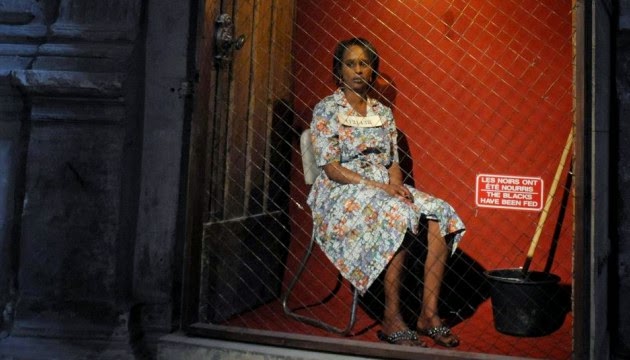
This live art installation represents a colonial human zoo in what attempts, according to Bailey, to 'explode racial and cultural stereotypes rather than reinforce them'; by placing motionless performers in different positions, the piece aims at confronting and denounce colonialism as well as white European supremacy.
Not so, say many people who protested and signed a petition and who managed to shut down the display at the Barbican in London last September. For its critics, this show is a way of reinforcing prejudices and denigrating Black people.
Similar scenes of protest have been seen in France this month.

Colonial human zoos, but is it art?
So, the burning question is here again. It has happened so many times, whenever a community feels offended by a representation, from the Satanic Verses to the Sikh community (or some members of it) demanding a play to be stopped, or more recently the case of the Tricycle theatre and the Jewish Film Festival.
I personally find it difficult to back any demand for a show to be censored, unless there is an element suggesting racial, ethnic, religious or gender hatred incitement. As this is clearly not case, I can only lament the fact that due to these protests many people will not be able to make their minds up.
The verdict, then, is pretty clear in this occasion; may Exhibit B offend and disgust some people? Certainly; Can it be labelled as provocative and thought-provoking? Indeed; Are there any grounds for it to be banned? Absolutely not.

Friday, 23 May 2014

James Lovelock:A true maverick of our time

Ways of seeing, ways of thinking
The recent publication of A Rough Guide to the Future is the perfect excuse to delve into the extraordinary figure that is the English scientist, environmentalist and writer James Lovelock.At 94, he is still going strong, defiant and controversial as usual.
He rose to fame in the 1970s when he published his Gaia theory, in which he argued that the Earth is a self-regulating entity, thus completely changing the way we understand and talk about the Earth.
Fiercely independent, he remains a true maverick who lives and works outside the main academic headquarters; his views are, therefore, rather unconventional and usually manage to enrage fellow scientists. His latest work, which I haven't read yet, seems to continue in the footsteps of previous books.
His staunch support of nuclear power and his scepticism towards renewable energies made him no friends among environmental campaigners; to many, this amounts to an irrational prejudice with no real scientific basis. In a recent interview in The Guardian he claims that the UK government should promote fracking, which again may raise a few eyebrows.
But for all these controversies and his perhaps sometimes misguided stance, Lovelock is by and large one of the most interesting voices in the scientific world whose curiosity and approach make him a true thinker of our time, an inventor and a person able to understand our future challenges like few do.

Tuesday, 25 March 2014

Journalism by Joe Sacco

Telling it like it is
The undeniable rise of the comic as a respected and widely enjoyed art form has been gathering pace over the last decade; comic artists are starting to enjoy accolades and a well-deserved recognition hitherto unknown. This blog has already written about some of the comic books we have come across in the past and we intend to keep doing so in the future. The wealth of talent and creativity remains huge so there is no excuse, really.
Joe Sacco is a Maltese-US citizen cartoonist and journalist; an intriguing combination that, one would imagine, could produce a more than interesting result.And this is exactly what happens with Sacco's work.
A fascinating mix of his acute observation skills, his drawing talent and his desire to try to understand global conflicts (some of them with very little media coverage), make of Sacco a unique comic-reporter whose work, dare I say, becomes compulsory reading for anyone with an interest in the world we live in.
On top of that, he always manages to portray realities that bring us a different perspective and may even challenge our -- as well as his own--  beliefs and assumptions.
Journalism is in reality a collection of short comics Sacco published over the past years in different magazines (eg The New York Times Magazine, Harper's Magazine or the French  XXI).
The book opens with a preface that is a masterpiece in journalism and should be read by aspiring journalists; in it, he challenges the much-vaunted term 'objectivity'; or as he calls it, the Holy of Holies of American (should he add British, too?) journalism.


What follows this edifying piece is a whirlwind tour around the hotspots on the map of conflicts; from Bosnia to Palestine; from the Indian dispossessed to the refugees arriving in his native Malta.
In true Sacco's fashion, he is another character in the stories and he depicts himself as the man he is in all circumstances. His presence and questions are often a risk for his witnesses who are very vulnerable, and he does not hide the fact that he is not always welcome.He can also be irritatingly annoying.
However, he manages to portray with astonishing yet compassionate objectivity the plight of the Chechen women; the humiliations suffered by the Iraqi recruits trained by the US army; the desperate no-man's land of the refugees arriving in Malta; and the harrowing conditions of the untouchable in India.
Heartbreaking, powerful and informative, this book reveals many dark stories, touches complex realities and defies stereotypes.It deserves a wider audience.

Wednesday, 29 January 2014

If I had a hammer...

The flowers have all  gone

For as far as I can remember, Peter Seeger has always been there: not in the spotlight but, rather, discreetly in the background encouraging new artists (including some Bob Dylan), promoting and pioneering causes (environmentalism), defending worker's and minorities rights (Civil Rights Movement), and ensuring that music remained connected to people as an authentic form of expression.And yet, as his recent death has proved, his influence amongst fellow musicians and fans was huge. As the cliché goes, with him an era also goes: that of the troubadour  popularising and revitalising  people's music whose authenticity credentials were unmatched.

Seeger's music, it seems to me, would be a fitting music background for Steinbeck's novels; it would accompany the Joad's odyssey in their desperate search for a better life in California, and it would be played as Lennie and George sought their (mis)fortunes among the dispossessed.But as most great artists, his music was understood and felt beyond his native America and the country's working clasess; Seeger's voice sang international causes too, from Cuba to the Spanish Civil War and the rise of totalitarianism in the Soviet Union (though he would remained a communist).
Peter Seeger represents, perhaps like no other, the example of a musician whose music became the soundtrack to people's struggles, accompanying endless fights for those who found themselves on the wrong side of History; the voiceless found one grave and clear voice in someone who was, above all, a symbol of integrity and bonhomie.
Let the future generations discover and cherish his legacy; if we make sure that this happens, then we will know that there will always someone with 'a hammer of justice... and a bell of love, all over this land'.
And that will be the best tribute to Peter Seeger.


Friday, 25 October 2013

Guerrilla Girls: The Avengers of Art


Naming and shaming: the conscience of modern art
Before the likes of Pussy Riot, Femen and other gender-orientated activist groups that have recently sprung up and have somehow created a new wave of feminism that has, once again, put this issue high on the agenda (or at least, I would like to think so), there was a group of women who were true pioneers in shaming and reacting against the old and long-lasting male hegemony in the arts.
Guerrilla Girls, always hiding behind the gorilla masks, were born almost thirty years ago after a supposedly 'international survey' of contemporary art at MoMa in New York had featured only 13 female artists out of a total of 169.
Their direct and simple approach brought a new social conscience and awareness hitherto ignored or forgotten which was further enhanced when they incorporated racial inequality as one of their flags. Through banners, t-shirts, artwork, stickers and also protests, they managed to disseminate their powerful and indisputable message: how institutional art (galleries, museums, academia etc...) had failed to incorporate or take into account women and ethnic minorities, beyond sexual and racial stereotypes.
Art books and exhibitions were overwhelmingly populated by white male artists; these activists, with their gorrila masks as a symbol of anonymity but also what they understood as the beauty cannon, set out to challenge and debunk outdated realities in a post-colonial context.

Of course, things have changed since the mid-80s and we have the Guerrilla Girls to thank them for this. But as the previously mentioned Femen (a Tea & Sympathy old post has already covered this group), Pussy Riot and others have shown, there is still a long way to go; contemporary art, and the wider society, desperately need more combative voices prepared to challenge and raise awareness. There's plenty of issues out there worth the fight.